
GrantRadar-AI
An AI-powered scholarship search engine that finds European master's programs matching what you've actually built, not your grades.
Built for personal use to support my own European master's applications. Not publicly deployed. Private repository, no public link.
What GrantRadar-AI does.
GrantRadar-AI is a scholarship search engine for European master's programs. It searches the live web, extracts structured requirements from official sources, cross-checks and deduplicates what it finds, runs deterministic eligibility rules, and scores the surviving candidates for fit, then writes a fit explanation that references the applicant's actual projects by name.
Three AI models sit inside a seven-layer pipeline. No model ever makes an eligibility decision. Every accept or reject is code, not a language model's opinion.
Every scholarship tool matches the wrong thing.
Existing scholarship search tools match on nationality, degree level, and GPA. They have no way to see what a person has actually built or done. Strong candidates with non-traditional academic records (founders, builders, self-taught engineers) get buried under irrelevant results or filtered out before anyone reads their story.
GrantRadar-AI matches on substance instead: shipped products, years of experience, a technical track record. Grades are one input among several, not the gate.
I built the tool I needed.
I have a 2.77 CGPA and five deployed AI products in production, 5+ years of B2B sales experience, and a clear technical founder identity. Every scholarship tool I tried filtered me out before anyone read the story behind the number. I was already evaluating my own candidacy by hand across programs like Erasmus Mundus, Chevening, the Swedish Institute, and Orange Corners, so I built a system to do that research systematically, and to surface programs that would actually weigh what I've shipped.
The seven-layer pipeline.
Layers 1, 2, and 7 are AI. Layers 3 through 6 are pure deterministic code, with no model involved. That split is the core design decision: language models find and read information, code decides who's eligible.
Inside GrantRadar-AI.
A walkthrough of the complete scholarship search workflow, from search initiation to AI-ranked recommendations.
The search begins with an applicant profile rather than a GPA threshold. GrantRadar-AI evaluates academic background, professional experience, deployed projects, target countries, and career goals before starting the seven-layer intelligence pipeline.
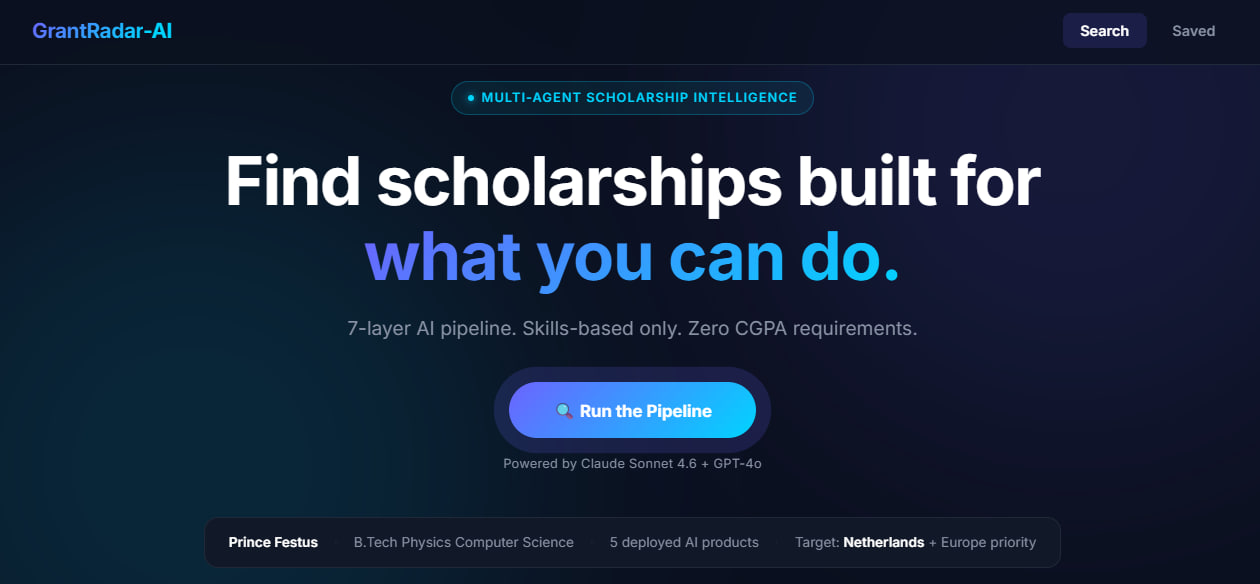
Each layer executes independently and reports its progress in real time. Claude searches official scholarship sources, extracts structured information, validates results, and passes verified data into deterministic eligibility rules before GPT-4o performs the final ranking.
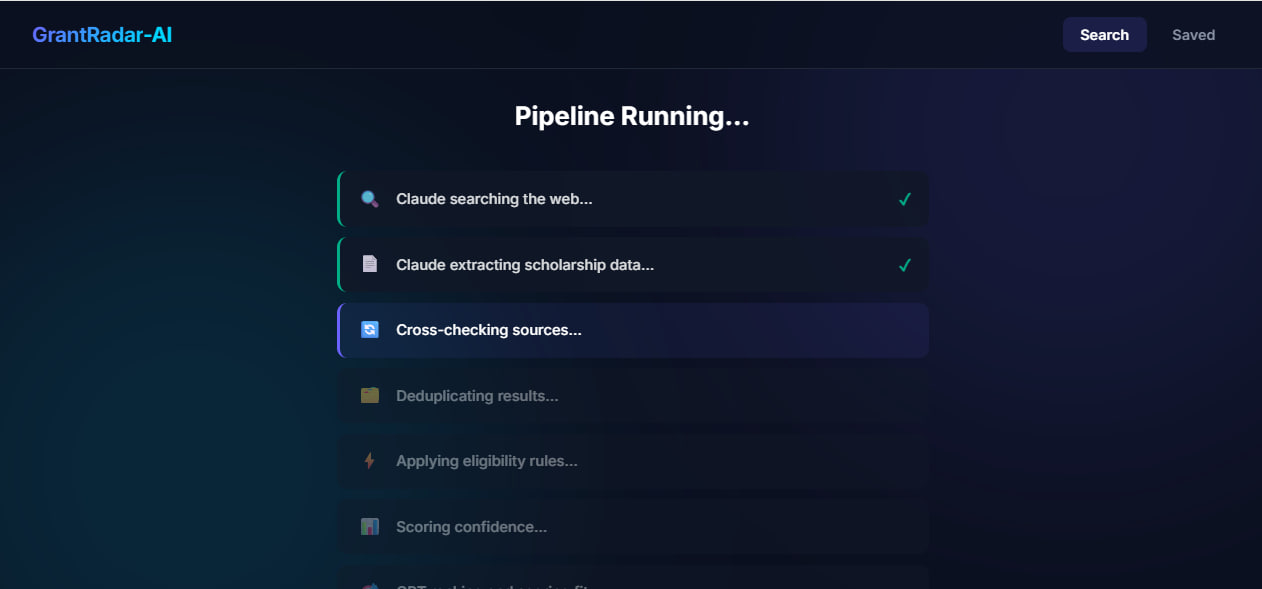
Unlike traditional AI search tools, language models never decide eligibility. Every scholarship passes through deterministic validation, deduplication, confidence scoring, and rule-based filtering before reaching the ranking engine.
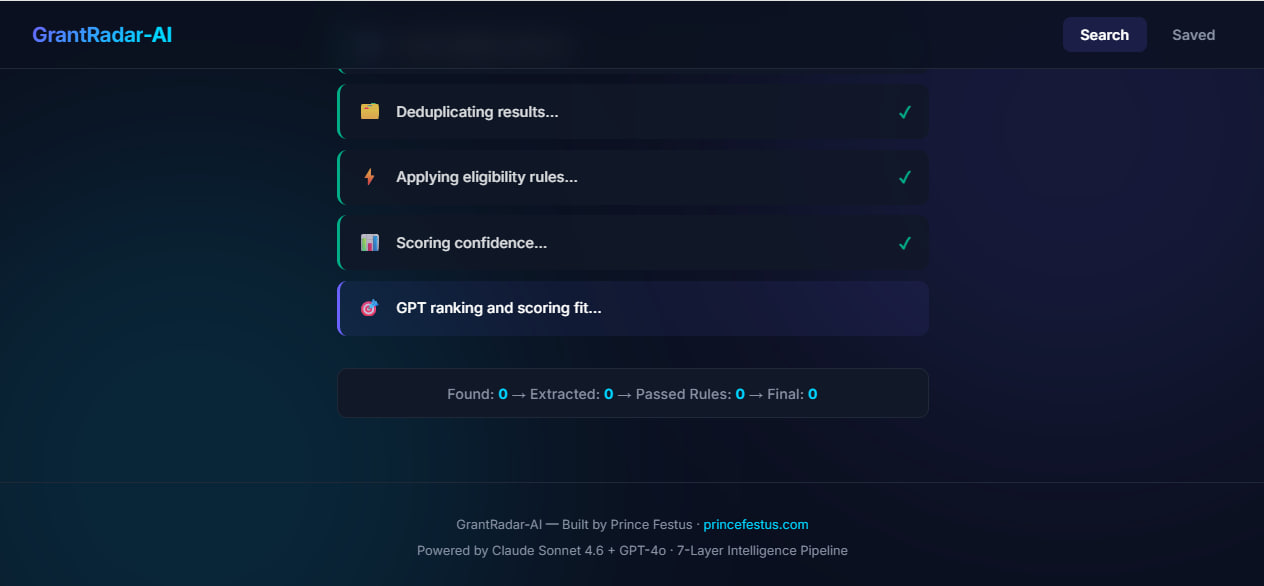
Only scholarships that survive the full pipeline are presented to the user. Each opportunity receives a weighted match score based on technical background, experience, projects, eligibility requirements, and confidence level.
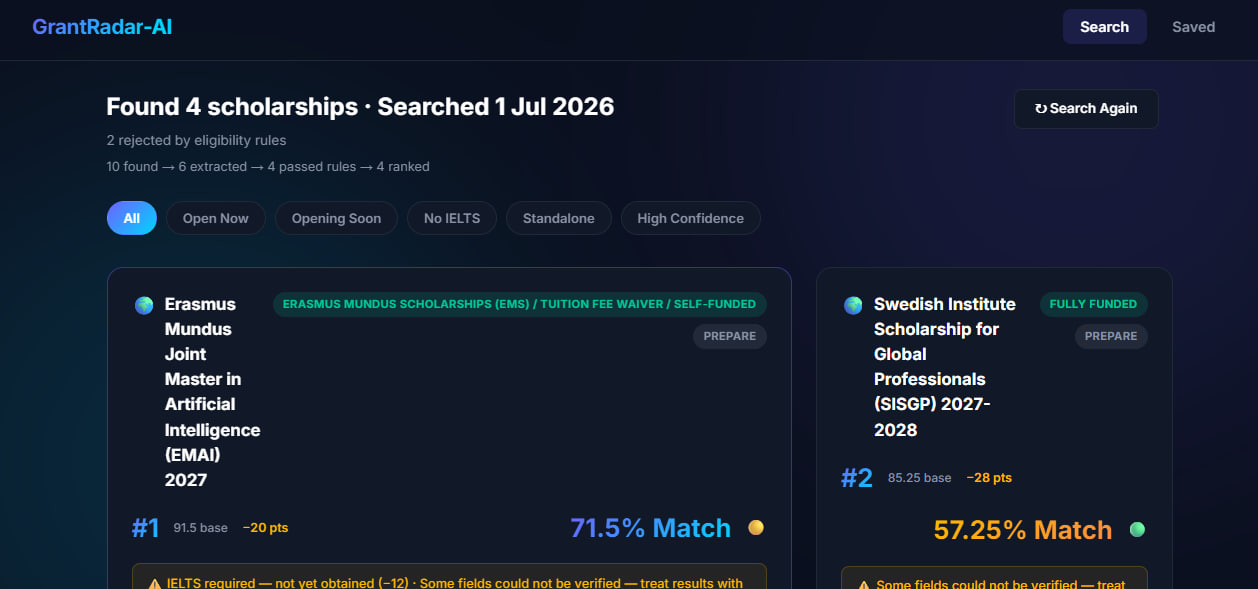
Instead of simply listing scholarships, GrantRadar-AI explains why each opportunity matches the applicant. Recommendations reference actual projects, professional experience, technical strengths, and highlight areas that should be emphasized in the application.
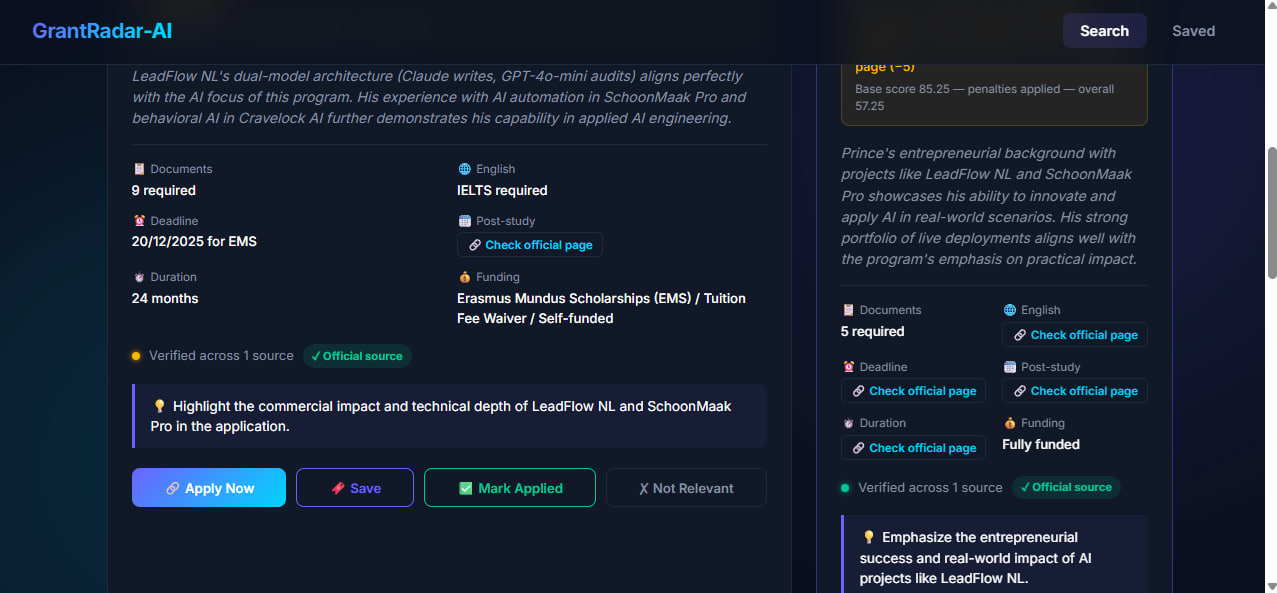
Every recommendation includes penalties, confidence indicators, verification status, funding information, required documents, language requirements, and direct links to official scholarship pages. The goal is complete transparency rather than black-box recommendations.
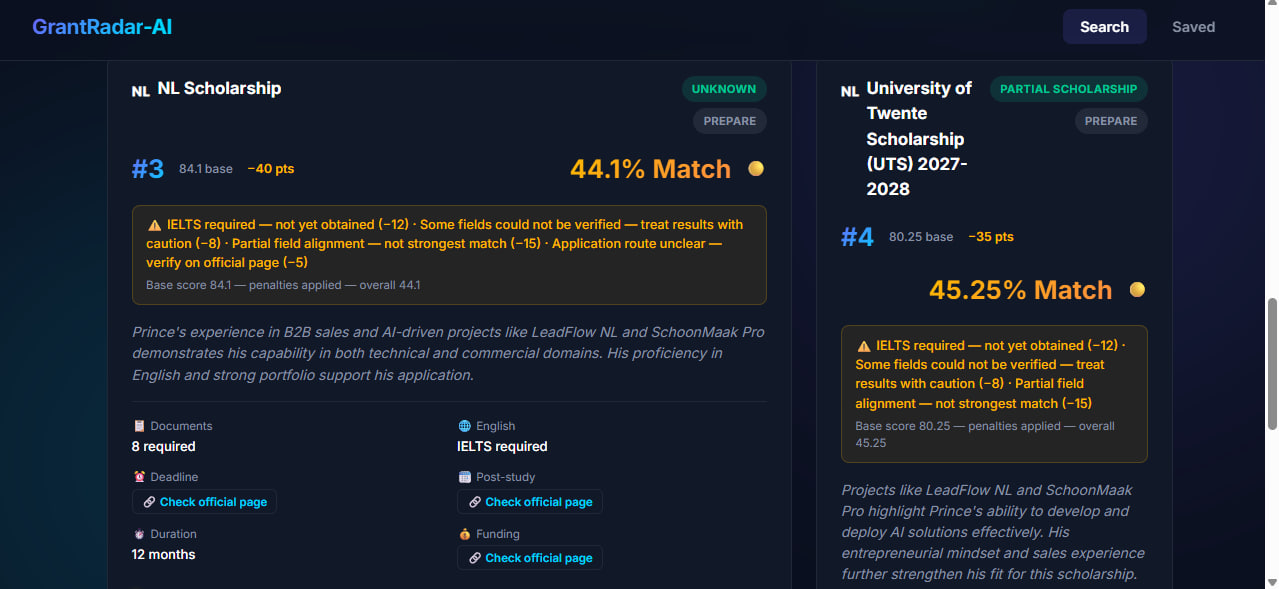
These screenshots were captured from a live deployment running on Railway using real API calls to Claude Sonnet 4.6, Claude Haiku 4.5, and GPT-4o. They demonstrate the production workflow of the complete seven-layer pipeline, not static mockups.
Where it stands.
Live and deployed on Railway. Tested end-to-end with real API calls: found 15 scholarship listings, extracted 13, passed 4 through all eligibility rules, ranked by GPT-4o. Not publicly deployed. This runs against a private repository for personal use.
What was hard to build.
The stack behind it.
Planned improvements.
Browser-rendered page fetching for the JavaScript-heavy sites that still slip past the current fallback. Real-time pipeline progress synced to a frontend animation, so a search feels transparent instead of like a black box. And an expanded, pre-seeded scholarship database to cut down on live search calls for programs that get looked up repeatedly.
What I bring to a team.
GrantRadar-AI was built in three to four days because I needed it, not because I was testing a market. The design decision that matters most, code owns eligibility and AI owns search and language, is the difference between a tool that's occasionally right and one that's verifiable every time.
GrantRadar-AI demonstrates designing multi-agent systems where trust is engineered in, not assumed: cost-optimized, hallucination-resistant, and honest about what it doesn't know.